
Both diseases attack your joints, but psoriatic arthritis usually brings skin and nail signs, uneven joint pain, and negative RA blood tests.
Swollen knuckles, stiff mornings, and sore wrists can point to either disease. That’s why psoriatic arthritis vs rheumatoid arthritis confuses so many people. Both are autoimmune diseases, and both cause joint pain. Still, they act differently, and the treatment can differ too. Getting the right name matters.
Here in Naples, FL, we meet plenty of people who got one label and still have questions. Some are snowbirds who saw a doctor up north. Others noticed a scaly patch after a summer on the Gulf. The board-certified team at RheumCare sorts out RA and PsA every week. This guide gives you the key differences explained in plain words. So, still guessing which one you have? Let’s clear it up.
TL;DR
• About 80% of people with RA test positive for RF or anti-CCP antibodies (RMD Open).
• Most people with PsA test negative for both markers.
• PsA affects up to 1 in 3 people with psoriasis.
• Women get RA 2 to 3 times more often than men.
• PsA affects men and women about equally.
Understanding Rheumatoid Arthritis and Psoriatic Arthritis
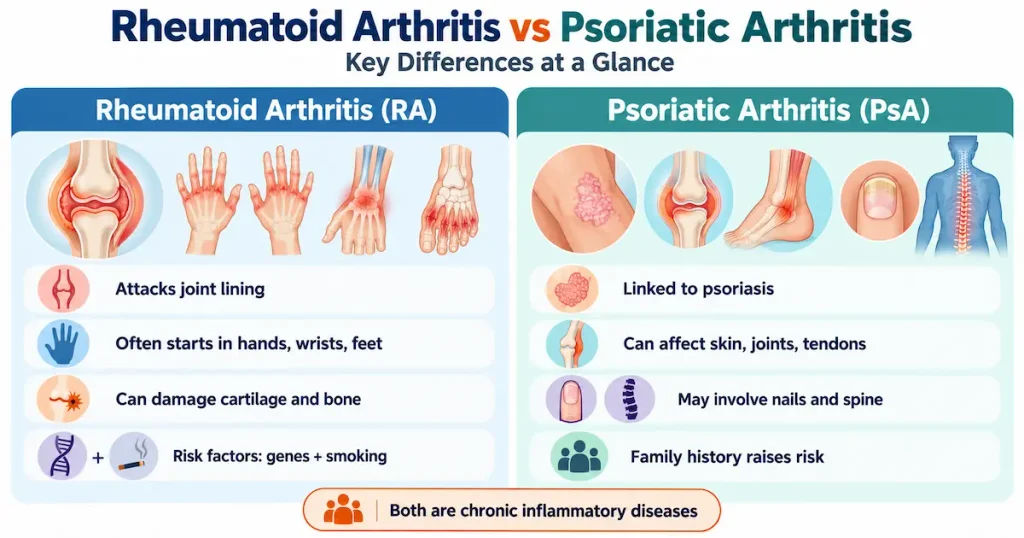
RA attacks the lining of your joints, while PsA grows out of psoriasis and hits the skin, joints, and tendons. Both are chronic inflammatory diseases. Each one has its own starting point.
Understanding Rheumatoid Arthritis
In RA, the immune system attacks the synovium, the thin lining inside your joints. That lining swells, thickens, and slowly wears away cartilage and bone. RA typically affects the small joints of the hands, wrists, and feet. It has no direct link to psoriasis. Doctors attribute the cause of RA to a combination of genetic factors and environmental triggers, with smoking being one of the strongest known risk factors. Recognizing early rheumatoid arthritis and managing autoimmune disease before symptoms progress can help readers better understand early warning signs and the importance of timely management.
Understanding Psoriatic Arthritis
PsA grows out of psoriasis, a skin condition that causes red, scaly patches. About 8 in 10 people get psoriasis first, sometimes 5 to 12 years before any joint pain. Up to 1 in 3 people with psoriasis develop PsA. Family history plays a big role too. If a parent or sibling has psoriasis, your risk goes up even if your skin looks clear. Inflammation in psoriatic arthritis can affect any joint, plus tendons, nails, and the spine.
Psoriatic Arthritis vs Rheumatoid Arthritis at a Glance
This side-by-side table shows the main differences between RA and PsA in one quick view.
| Feature | Psoriatic Arthritis (PsA) | Rheumatoid Arthritis (RA) |
| Main link | Psoriasis | Immune attack on the joint lining |
| Skin and nails | Scaly patches, nail pits | Usually none |
| Joint pattern | Often one side of the body | Usually both sides |
| Finger joints | Tip joints near the nails | Knuckles and middle joints |
| Sausage fingers | Common | Rare |
| Tendon and heel pain | Common | Less common |
| Lower back and spine | Often involved | Rarely involved |
| RF and anti-CCP tests | Usually negative | Positive in about 80% |
| Eye problems | Red, painful eye (uveitis) | Dry eyes more common |
| Who gets it more | Men and women equally | Women 2 to 3 times more |
Skin and Nails
Psoriatic Arthritis (PsA): PsA often comes with red patches covered in a silvery scale. They show up most on the scalp, elbows, knees, lower back, and belly button. Nails may pit with tiny dents, lift off the nail bed, or grow thick and chalky. Many people mistake these nail changes for a fungus. Up to 80% of people with PsA get nail changes at some point.
Rheumatoid Arthritis (RA): RA usually leaves the skin and nails alone. Some people get firm, painless bumps under the skin called rheumatoid nodules. These often form near the elbows, fingers, or heels. They appear more often in people who test positive for RF.
Joint Pattern
Psoriatic Arthritis (PsA): PsA often hits joints unevenly, like one knee and a few toes on the other foot. It may start in just one to four joints, often on one side of the body. Over time, it can spread to both sides. This uneven pattern is one of the first clues doctors look for.
Rheumatoid Arthritis (RA): RA usually hits joints on both sides at once. If your right wrist hurts, your left wrist often hurts too. It tends to start in the small joints of the hands and feet. Later, it can move to the knees, shoulders, elbows, and ankles. These patterns of joint involvement help differentiate the two diseases.
Finger Joints
Psoriatic Arthritis (PsA): PsA often hits the tip joints closest to the nails, called the DIP joints. Nail changes often show up on the same fingers with sore tips. In rare, severe cases, PsA can wear away bone and shorten a finger. Early care helps lower that risk.
Rheumatoid Arthritis (RA): RA targets the knuckles (MCP joints) and the middle finger joints (PIP joints). These smaller joints take the hardest hit, while the tip joints usually stay clear. Over years without treatment, fingers can drift sideways toward the pinky. Gripping a golf club, a car key, or a jar lid can start to hurt.
Sausage Fingers
Psoriatic Arthritis (PsA): PsA can swell a whole finger or toe like a sausage. Doctors call this dactylitis. It happens because the joints and tendons in that digit swell at once. Up to half of people with PsA get it at some point. A swollen toe that makes your shoes feel tight is a common example.
Rheumatoid Arthritis (RA): RA rarely swells a whole finger or toe. The swelling stays around each joint, so the finger looks puffy only at the knuckles. That difference helps doctors tell the two apart during a quick exam.
Tendon and Heel Pain
Psoriatic Arthritis (PsA): PsA often attacks the spots where a tendon or ligament attaches to bone. Doctors call this enthesitis. The back of the heel and the bottom of the foot hurt most. Elbows and knees can be affected too. Many Naples golfers, tennis players, and pickleball players blame their sport for this pain. Pain that lasts for weeks deserves a checkup.
Rheumatoid Arthritis (RA): RA causes this kind of tendon pain less often. Its tendon problems usually come from swollen joints nearby, like in the wrist or hand. Some people with RA get carpal tunnel symptoms, such as numb or tingling fingers.
Lower Back and Spine
Psoriatic Arthritis (PsA): PsA can inflame the spine and the joints where the spine meets the pelvis. Doctors call this axial PsA or psoriatic spondylitis. The pain often feels worse after rest or sleep and better with movement. Stiffness after a long drive up I-75 is a common example.
Rheumatoid Arthritis (RA): RA rarely affects the lower back. It can affect the upper neck, especially after many years with the disease. Neck pain with numb or weak arms needs quick care. It can point to pressure on the nerves.
Eye Problems
Psoriatic Arthritis (PsA): PsA can cause uveitis, an inflammation inside the eye. It often comes on fast, with redness, pain, blurry vision, and light sensitivity. Some people also get pink eye. Uveitis needs quick care from an eye doctor to protect your vision.
Rheumatoid Arthritis (RA): RA more often causes dry, gritty, or burning eyes. Some people also develop Sjögren’s syndrome, which dries both the eyes and the mouth. Less often, RA inflames the white of the eye, causing deep, aching pain.
Who Gets It More
Psoriatic Arthritis (PsA): Men and women get PsA at about the same rate. It often starts between ages 30 and 50, but it can start at any age. People with severe psoriasis, scalp psoriasis, or nail changes face a higher risk. So do people with a family history of psoriasis or PsA. The American College of Rheumatology offers a patient guide to psoriatic arthritis.
Rheumatoid Arthritis (RA): Women are more likely to get RA, about 2 to 3 times more often than men. It often begins in middle age, but it can start earlier or later. Smoking, family history, and obesity all raise the risk. Collier County has a large over-45 population, so RA questions come up often here.
What Do Your Blood Test Results Mean?
RA blood tests usually come back positive, while PsA blood tests usually come back negative. Doctors check two markers. Rheumatoid factor (RF) is an antibody linked to RA. Anti-CCP is a second antibody that points strongly to RA.
Psoriatic Arthritis (PsA): Most people with PsA test negative for both RF and anti-CCP. Doctors call this seronegative arthritis. A negative result doesn’t rule PsA out, and a small number of people with PsA do test positive. Doctors rely more on skin, nails, joint pattern, and imaging to confirm it.
Rheumatoid Arthritis (RA): A review in RMD Open found that about 80% of people with RA test positive for RF, anti-CCP, or both. Anti-CCP points to RA more strongly than RF, because few other conditions cause it. RF can show up in some healthy older adults and in other diseases. So doctors read both tests together with your symptoms.
| Result | What It Usually Means |
| Positive RF or anti-CCP | Points toward RA |
| Negative RF and anti-CCP | Fits PsA, but doesn’t rule out RA |
| RF positive with no symptoms | Can happen in healthy people too |
No single test settles rheumatoid arthritis or psoriatic arthritis. Blood tests work best alongside an exam and imaging.
How Do Doctors Tell PsA and RA Apart?
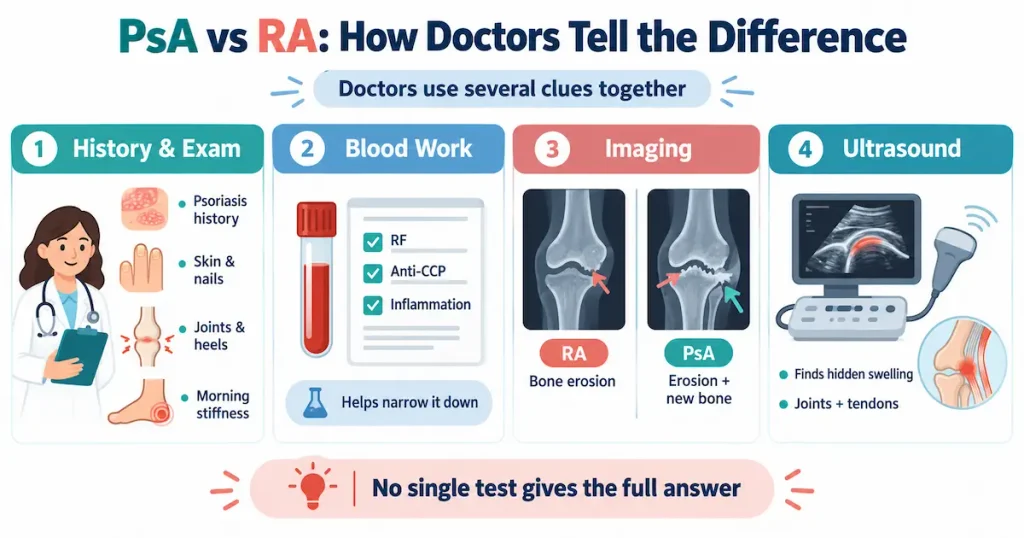
A rheumatologist uses your history, an exam, blood work, and imaging together to make an accurate diagnosis. An accurate diagnosis rarely comes from one clue. It comes from putting several together. At RheumCare, our rheumatologists review these pieces together. See what to expect at your first appointment.
Exam and Health History
Your doctor asks about psoriasis in you or your family. They check your skin, nails, joints, and heels. They also ask how long your stiffness lasts each morning.
Blood Work
Labs check RF, anti-CCP, and inflammation levels. These results narrow the list, but they don’t decide alone.
X-Rays and Ultrasound: Spotting Psoriatic Arthritis vs Rheumatoid Arthritis
X-rays show bone damage patterns. RA wears bone away. PsA can wear bone away and also build new bone near the joint. Ultrasound shows swelling in joints and tendons that X-rays can miss. Learn more about how RA is diagnosed.
How Are Psoriatic Arthritis and Rheumatoid Arthritis Treated?
Several medicines work for both conditions, but the best plan depends on which joints, skin, and spine are affected. The goal in both diseases is to calm inflammation and protect your joints from lasting damage. For PsA, the American College of Rheumatology lists anti-inflammatory pills, steroid shots, disease-modifying drugs (DMARDs), and biologics as common options. RheumCare provides rheumatoid arthritis treatment in Naples, FL, with infusions and injections on site.
People with more severe disease may try biologics. Because the two diseases work differently inside the body, a therapy can work better for one than the other, so your rheumatologist matches the medicine to your pattern and test results. You can read about biologic and infusion therapy options for autoimmune disease before your visit.
Starting early matters. Early treatment is linked to better outcomes and less joint damage, so don’t wait if symptoms last.
FAQs
Is Psoriatic Arthritis Worse Than Rheumatoid Arthritis?
Neither one is simply worse. Both can damage joints without care. Severity depends on the person, how early treatment starts, and how well it works. A rheumatologist can explain your own risk after reviewing your exam, blood work, and imaging.
Can RA Turn Into Psoriatic Arthritis?
No. RA and PsA are separate diseases. One doesn’t turn into the other, though early signs can look alike and change a diagnosis. That is why a careful exam of your skin, nails, joints, and blood work matters from the start.
Can You Have Psoriatic Arthritis With a Negative Blood Test?
Yes. Most people with PsA test negative for RF and anti-CCP. Doctors diagnose it through your skin, nails, joint pattern, and imaging. A negative result doesn’t rule PsA out, and a small number of people with PsA do test positive.
Which Is More Common, PsA or RA?
RA is more common overall. PsA mostly shows up in people who already have psoriasis, affecting up to 1 in 3 of them. Women get RA 2 to 3 times more often than men, while PsA affects men and women about equally.
Does Psoriatic Arthritis Affect Both Sides of the Body?
It can. PsA often starts on one side, but some people get swelling on both sides. That’s why doctors look at more than one sign. RA more often hits matching joints on both sides at once, so skin, nails, and blood tests help sort it out.
Does RheumCare Treat Both PsA and RA?
Yes. RheumCare’s board-certified rheumatologists diagnose and treat both at two Naples offices, with infusions and injections on site. Your visit includes a review of your symptoms, labs, and imaging together, so you leave with clear next steps. Call (239) 262-6550 to book.
Are Psoriatic Arthritis and Rheumatoid Arthritis Treated Differently?
Treatment often overlaps, since several medicines work for both conditions. Still, the best plan depends on which joints, skin, and spine are affected. A rheumatologist chooses therapy based on your pattern, symptoms, and test results. Early treatment helps protect your joints.
Get the Right Diagnosis in Naples, FL
Psoriatic arthritis vs rheumatoid arthritis comes down to skin, nails, joint pattern, and blood tests. The right label leads to the right treatment. Lasting joint pain, morning stiffness, or a swollen finger or toe deserves a closer look from a specialist. At RheumCare, our board-certified team reviews your symptoms, labs, and imaging together. Not sure which one you have? Book with RheumCare at 6605 Hillway Circle or 2340 Vanderbilt Beach Rd. Call (239) 262-6550 today to schedule an appointment with our team.