
Rheumatoid arthritis fatigue is real, and it is one of the most common symptoms of RA. The NIAMS rheumatoid arthritis overview lists fatigue (feeling unusually tired or having low energy) as a common RA symptom. RheumCare, a board-certified rheumatology practice in Naples, FL, evaluates and treats RA fatigue for patients across Collier and Lee Counties. This guide explains why RA makes you so tired, how a rheumatologist identifies the specific cause, and which treatments and daily habits help restore your energy.
TL;DR
● Short answer: Inflammatory chemicals called cytokines, such as TNF-alpha and IL-6, are thought to drive RA fatigue by affecting stress hormones and sleep.
● Other causes add to it: poor sleep, pain, low mood, anemia, thyroid problems, fibromyalgia, muscle loss, and medications such as methotrexate.
● Fatigue can persist even when joints improve, so it needs its own plan.
● What helps: optimizing RA treatment, regular movement and strength training, better sleep, energy pacing, and checking for hidden causes.
● Next step: track your fatigue for two weeks, then see a rheumatologist.
What Does RA Fatigue Feel Like?
RA fatigue is exhaustion that rest often does not resolve. Arthritis Research Canada notes that a shower, coffee, or a good night’s sleep does not improve arthritis fatigue.
It is also widespread. The Hospital for Special Surgery reports that 40% to 80% of people with RA experience fatigue at some point. HSS suggests a self-check: if your fatigue is out of proportion to your activity, raise it at your next visit.
Why Does Rheumatoid Arthritis Make You So Tired?
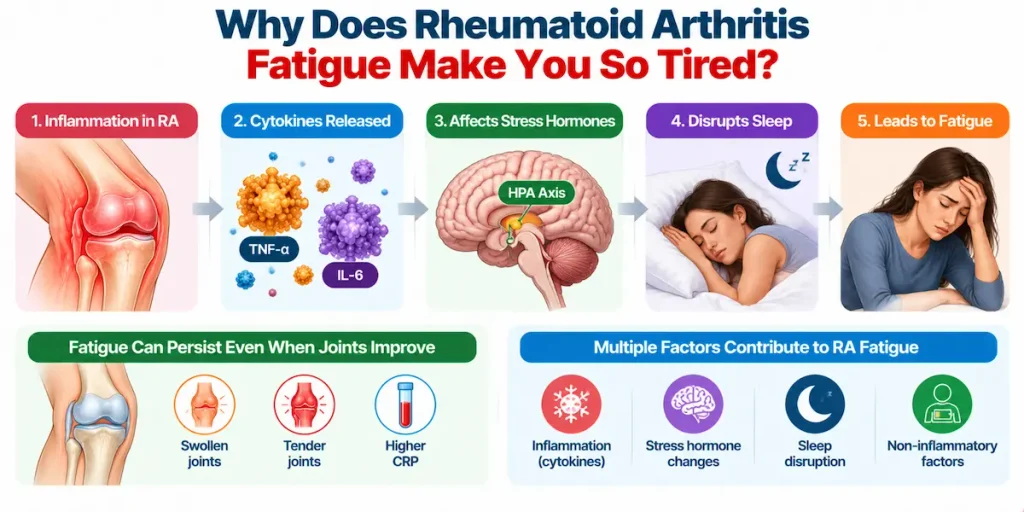
Inflammation is one major driver. The same immune chemicals that inflame your joints are thought to affect your stress hormones and sleep.
Inflammation and Fatigue: The Cytokine Connection
In RA, the immune system releases inflammatory messengers called cytokines, including TNF-alpha and IL-6. Research on RA fatigue causes reports that these cytokines can disrupt the hypothalamic-pituitary-adrenal (HPA) axis, the system that regulates stress hormones, and alter the sleep-wake cycle. It also cites a meta-analysis in which biologics that block these cytokines significantly reduced fatigue.
A review of RA fatigue predictors links these cytokines to fatigue through “sickness behavior,” the same response that makes you want to rest during an infection.
Why Fatigue Can Stay After Your Joints Improve
Joint improvement does not guarantee more energy. An 8-year Leiden cohort study of 626 RA patients found that fatigue remained stable despite treatment. More swollen joints, more tender joints, and higher CRP were tied to more fatigue, but the effect was small, which suggests non-inflammatory pathways also play a role.
For that reason, fatigue deserves its own measurement. Rheumatology researchers treat fatigue as an essential outcome in RA and link it to standard disease activity scores. Ask your rheumatologist to track it on a 0 to 10 scale, a common method HSS describes.
Other Causes That Make RA Exhaustion Worse
Several conditions add to RA exhaustion, and HSS advises looking for and treating each one.
● Sleep disruption: More than half of RA patients report disturbed sleep, which is associated with fatigue, pain, and depressed mood.
● Pain and mood: The predictors review above finds that pain, mood, and disability appear to drive RA fatigue.
● Anemia and thyroid disease: Arthritis Research Canada notes that many people with RA also have anemia, hypothyroidism, or cardiovascular disease, all of which affect energy levels.
● Fibromyalgia: About 1 in 5 people with RA also have fibromyalgia, which is associated with more fatigue and anxiety.
● Muscle loss: A 2018 meta-analysis of rheumatoid cachexia, a loss of muscle mass linked to RA, estimated that it affects 15% to 32% of people with RA, depending on how it is defined.
Can RA Medications Cause Fatigue?
Yes. Arthritis Research Canada describes methotrexate as notorious for causing fatigue. In a prospective study of methotrexate users that included 353 people with RA or psoriatic arthritis in the ArthritisPower patient registry, fatigue was the most frequently reported side effect (46%). Among participants who already had fatigue, scores rose significantly in the 6 to 36 hours after the weekly dose.
If your worst day follows your dose day, tell your rheumatologist. The American College of Rheumatology explains that folic acid can reduce side effects, that methotrexate comes as pills or an injection, and that the dose is sometimes split in two to avoid side effects. Never skip or change a dose on your own.
Is It RA Fatigue or Something Else?
The timing and pattern of your tiredness offer clues to its source.
| Pattern You Notice | Possible Cause | What to Do |
| Fatigue along with more swollen or tender joints | Active inflammation | Contact your rheumatologist; treatment may need adjustment |
| Fatigue within 36 hours after your weekly dose | Methotrexate side effect | Log dose days and ask about folic acid, split dosing, or injections |
| Fatigue and aches within days of lowering prednisone | Steroid withdrawal or a flare | Call your rheumatologist before changing your dose |
| Poor or broken sleep most nights | Sleep disturbance | Report sleep problems at your visit |
| Low mood, worry, or loss of interest | Depression or anxiety | Ask about a mood screening |
| Widespread pain beyond your joints | Fibromyalgia | Ask whether fibromyalgia is contributing |
| Fever, cough, or other signs of infection while taking methotrexate | Infection | Contact your rheumatology provider promptly |
| Shortness of breath with fatigue | Anemia, lung or heart involvement, or, rarely, a methotrexate lung reaction | Contact your rheumatologist promptly; seek emergency care if severe |
Watch the prednisone taper. According to Mayo Clinic guidance on prednisone withdrawal, tapering prednisone too quickly can cause severe fatigue, weakness, body aches, and joint pain, and in RA it can also cause symptoms to flare. Never stop prednisone abruptly; your rheumatologist sets the taper.
How a Rheumatologist in Naples, FL Evaluates Fatigue
A rheumatologist compares how tired you feel with how active your RA is, then looks for other causes that add to fatigue.
The key question is whether your fatigue matches your inflammation. The fibromyalgia review cited above adds that fibromyalgia can raise disease activity scores even when swollen joint counts, ESR, and CRP stay low. When fatigue outpaces those markers, the search shifts to fibromyalgia, sleep problems, mood, anemia, thyroid disease, or medication timing.
A fatigue evaluation typically includes:
● A joint exam for swelling and tenderness
● Blood work for inflammation markers such as ESR and CRP
● Blood work to check for anemia and thyroid problems
● A review of your sleep, mood, and medication timing
If you are new to RheumCare, review what to expect at your first appointment and bring your fatigue log.
What Actually Helps RA Fatigue?
Controlling inflammation comes first, followed by treatment of each added factor.
Optimize Your RA Treatment
In a small 12-month study of biologic therapy without a control group, RA patients who started biologics reported a significant reduction in fatigue.
Fatigue can also follow a pattern around each dose. A study tracking fatigue around biologic injections followed 398 patients with inflammatory rheumatic diseases across three injections and found that 13% showed a consistent worsening pattern and 18% an improving one. Note dose days in your fatigue log.
RheumCare provides infusion therapy at our Naples center for medications including Actemra, Orencia, Remicade, and Rituxan.
Move More, Gently
The CDC recommends at least 150 minutes of moderate aerobic activity a week for adults with arthritis, plus muscle-strengthening activity at least 2 days a week. It states that physical activity can help reduce joint pain and improve function and mood, and that sessions of just 5 or 10 minutes are beneficial. During hot Southwest Florida summers, schedule walks for early morning, exercise indoors, or try water exercise.
Protect Your Sleep and Pace Your Energy
Report sleep problems to your rheumatologist. Ask about cognitive behavioral therapy for insomnia (CBT-I); Arthritis Research Canada is developing and testing a CBT-I program designed for people with arthritis.
Pacing helps too. HSS notes that understanding how your fatigue shows up helps you plan and cope, so schedule demanding tasks for your best hours and split chores into shorter blocks.
Track Your Fatigue Before Your Appointment
Two weeks of tracking shows your rheumatologist patterns that memory can miss. Fill in one row per day and bring the log to your visit. The sample entries below show how a completed log might look; replace them with your own.
| Day | Fatigue (0-10) | Hours Slept | Med/Infusion Day? | Activity | What Helped or Worsened It |
| Day 1 (sample) | 4 | 7 | No | 20-minute walk | Felt better after the walk |
| Day 2 (sample) | 7 | 6 | Methotrexate dose | Light housework | Tired by early afternoon |
| Day 3 (sample) | 8 | 5 | Day after dose | Rested most of the day | Woke up twice with joint pain |
| Day 4 (sample) | 5 | 7 | No | Water exercise | Energy improved by evening |
| Days 5 to 14 | Your rating | Your hours | Yes or no, and which medication | What you did | What helped or made it worse |
Look for repeats, such as the same difficult day each week, low energy after poor sleep, or changes around an infusion or injection.
When Should You See a Rheumatologist About Fatigue?
See a rheumatologist if fatigue limits your work, family time, or daily routine. Contact your rheumatologist promptly if fatigue comes with any of the following:
● Fever, cough, or other signs of infection
● Loss of appetite
● Shortness of breath
● New symptoms after a medication change, such as starting methotrexate or lowering prednisone
NIAMS lists occasional fever, loss of appetite, and lung and heart problems among the ways RA can affect the body beyond the joints. The ACR notes that methotrexate can lower your ability to fight infections and advises contacting your rheumatology provider for symptoms such as fever or cough. The Johns Hopkins Arthritis Center lists rare lung problems among methotrexate side effects. Seek emergency care right away for chest pain, severe shortness of breath, or fainting.
If you are unsure whether your symptoms point to RA, use this symptom checklist for seeing a rheumatologist.
If you split the year between Florida and another state, keep lab monitoring on schedule wherever you are; the ACR states that regular laboratory monitoring is required while taking methotrexate. RheumCare has two Naples offices, including Hillway Circle, and Dr. Alain Alvarez provides care in English and Spanish. Meet our rheumatology providers to find the right fit.
Frequently Asked Questions
Is Fatigue a Sign My Rheumatoid Arthritis Is Getting Worse?
Not necessarily. Fatigue that rises along with more swollen or tender joints can signal increased inflammation. Fatigue without new joint symptoms can come from other causes, such as poor sleep, low mood, anemia, thyroid problems, or medication. Track both for two weeks, then share the pattern with your rheumatologist.
Can Methotrexate Make Me Feel Tired?
Yes. In a study of 353 methotrexate users with RA or psoriatic arthritis, 46% reported fatigue, and in those with baseline fatigue, scores rose in the 6 to 36 hours after the weekly dose. Your rheumatologist may adjust folic acid, split the dose, or switch to an injectable form.
Why Am I Still Exhausted When My Joints Feel Better?
Joint control and energy do not always improve together. In a large 8-year study, fatigue remained stable despite treatment, and its link to inflammation was small. Sleep, mood, pain, anemia, thyroid problems, and muscle loss each deserve separate evaluation and treatment.
What Blood Tests Check for RA Fatigue?
Blood work typically checks for anemia, thyroid problems, and inflammation markers such as ESR and CRP. Your rheumatologist compares those results with your joint exam and symptoms, because fatigue that outpaces inflammation points toward other causes, including fibromyalgia, sleep problems, or mood changes.
Does Exercise Help or Hurt RA Fatigue?
Regular, joint-friendly exercise is recommended. The CDC says physical activity can help reduce joint pain and improve function and mood. It recommends at least 150 minutes of moderate activity weekly, plus muscle-strengthening activity 2 days a week. Adjust activity during flares.
Where Can I Find a Rheumatologist Near Me in Naples, FL?
RheumCare is a board-certified rheumatology practice with two Naples offices, including 6605 Hillway Circle, Unit 101, Naples, FL 34112. Our team offers infusion therapy for RA medications such as Actemra, Orencia, and Remicade, plus bilingual Spanish care with Dr. Alain Alvarez. New patients are welcome.
Conclusion
Rheumatoid arthritis fatigue has identifiable causes: inflammation, disrupted sleep, pain, low mood, anemia, thyroid problems, fibromyalgia, muscle loss, and medication timing. Finding the cause that applies to you turns a vague complaint into a clear treatment plan. Start your two-week fatigue log today and bring it to your next visit. The RheumCare team in Naples, FL, serving patients across Collier and Lee Counties, will review your pattern, check for hidden causes, and build a plan with you.
Schedule an appointment today by calling (239) 262-6550.