
Rheumatology care in Collier County is covered under Medicare Part B when it is medically necessary. You generally pay 20% of the Medicare-approved amount after meeting your yearly deductible. Your plan type decides whether you need a referral first, so a few quick checks before you call can save you money and a wasted trip.
Rheumatology care in Collier County is covered under Medicare Part B when it is medically necessary. You generally pay 20% of the Medicare-approved amount after meeting your yearly deductible. It explains what Medicare pays, how referrals work, how to find a rheumatologist that accepts Medicare, and what happens at your first visit.
Key Takeaways
- Part B covers medically necessary rheumatology visits, lab tests, and imaging.
- The 2026 Part B deductible is $283. After that, you pay 20% of each approved service.
- Part B pays for infusions given in a medical office. Part D pays for drugs you take or inject at home.
- Confirm your exact plan with the office before you book.
Does Medicare Cover a Rheumatologist in Collier County?

Yes. Medicare Part B covers rheumatologist visits, lab tests, and imaging when they are medically necessary, and Collier County residents receive the same benefits as patients anywhere in the country.
The 2026 Part B deductible is $283, according to the Federal Register. After you meet it, you owe 20% coinsurance, which is your share of each Medicare-approved bill. Follow-up visits work the same way, so your yearly cost depends on how often you need care.
A Medigap plan can pay part or all of that 20%. Medicare Advantage plans have their own cost-sharing requirements, so your copays and coinsurance vary by plan. Review RheumCare’s accepted insurance plans first, then call to confirm that your exact plan is accepted.
What Does a Medicare Rheumatologist Visit Cost in 2026?
Most Original Medicare patients pay the $283 deductible once a year and then 20% of each approved rheumatology service. The table below shows how that pattern applies to three common types of care.
| Type of Care | Original Medicare | Medicare Advantage | Medigap |
| Office visit | 20% of the approved amount after the deductible | Copay set by your plan | Pays part or all of the 20% |
| X-ray or ultrasound | 20% of the approved amount after the deductible | Copay or coinsurance set by your plan | Pays part or all of the 20% |
| Office-based infusion | 20% of the approved amount, with no yearly cap | Capped by your plan’s out-of-pocket maximum | Pays part or all of the 20% |
These are typical patterns, not a quote. Your exact cost depends on your plan, so confirm the numbers with your plan and with RheumCare before your visit.
Which Conditions and Symptoms Call for a Rheumatologist?
A rheumatologist treats diseases of the joints, muscles, and immune system, including rheumatoid arthritis, lupus, psoriatic arthritis, gout, and polymyalgia rheumatica. You can browse the conditions RheumCare treats to see how each diagnosis is managed in Naples.
Book a visit if you notice joint swelling, morning stiffness that lasts about an hour, or joint pain paired with deep tiredness. Early care protects your joints, so learn when to see a rheumatologist instead of waiting for symptoms to worsen. Osteoarthritis that stops responding to usual treatment also deserves a rheumatology visit.
How Does Medicare Part B Infusion Coverage Work?
Part B pays for infusions that a clinician gives you in an office or infusion center, while Part D pays for drugs you inject or swallow at home. That split decides which plan receives the bill.
Infliximab and rituximab are two infused drugs used for rheumatoid arthritis. After your deductible, you pay 20% of each approved infusion. Original Medicare sets no yearly cap on that 20%, but a Medigap plan pays part or all of it.
Some plans require prior authorization, which means the plan approves a drug before you receive it. The prescribing office sends the request, so tell the team which plan you carry. Many Medicare Advantage plans also limit your yearly spending with an out-of-pocket maximum.
RheumCare offers treatment at its infusion center in Naples, allowing you to receive care close to home instead of traveling outside the county.
Do You Need a Medicare Advantage Rheumatology Referral?
Most Medicare Advantage HMO plans require a referral, while PPO plans usually do not. Original Medicare generally does not require one to see a specialist. Medicare Interactive explains the difference: HMOs commonly ask for referrals, while PPOs typically do not.
| Plan Type | Referral Needed? | Out-of-Network Care |
| Original Medicare | No | Any doctor who takes Medicare |
| Medigap | No | Any doctor who takes Medicare |
| Medicare Advantage HMO | Yes, in most plans | Limited |
| Medicare Advantage PPO | No, in most plans | Covered at a higher cost |
| Special Needs Plan (SNP) | Each plan decides | Each plan decides |
A referral is not the same as prior authorization. Your primary care doctor may provide the referral, while your health plan determines whether prior authorization is required. If your plan wants a referral, call your primary care office first and ask them to send it to RheumCare before you book.
How Do You Find a Rheumatologist That Accepts Medicare in Naples?
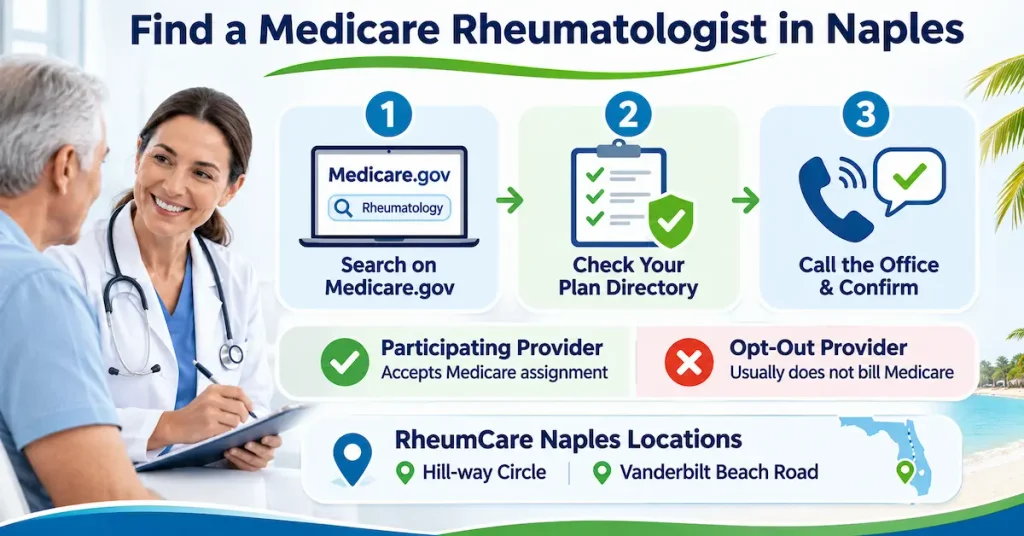
Search for rheumatology on the Medicare.gov provider search using your Naples ZIP code, then confirm the doctor with your plan and the office. Three steps keep it simple:
- Search for rheumatology on Medicare.gov.
- Check your plan’s provider directory.
- Call the office and ask three questions: Does the office take my exact plan? Is a referral required? Who sends prior authorization?
A doctor can accept Medicare and still sit outside your Medicare Advantage network, so confirm both. A participating provider accepts Medicare assignment, meaning the provider agrees to accept the Medicare-approved amount as full payment for covered services, subject to applicable deductibles and coinsurance. An opt-out provider generally does not bill Medicare for services covered by a private contract with the patient.
RheumCare has locations on Hill-way Circle and Vanderbilt Beach Road in Naples, which keeps specialist care within reach for patients from Golden Gate, Marco Island, Ave Maria, and Immovable.
What Happens at Your First Medicare Rheumatologist Visit?
You will talk through your symptoms, receive a joint exam, and leave with a care plan. Bring your Medicare card, any Medicare Advantage card, a list of your medicines, and old X-rays.
Your doctor may order blood tests for inflammation and for antibodies such as rheumatoid factor. X-rays or ultrasound follow when the exam calls for them. Part B covers these tests when they are medically necessary.
Joint exams need hands-on contact, so plan to come in person for the first visit. Read what to expect at your first appointment so you arrive prepared.
How Does Medicare Cover Rheumatology Drugs?
Part D covers self-injected and oral rheumatology drugs, and each plan keeps a formulary, which is its list of covered drugs. Check that list before you fill a prescription. Some Part D plans may require prior authorization for certain rheumatoid arthritis medications, depending on the drug and plan formulary.
Part D also has an annual out-of-pocket spending limit. The applicable 2026 limit should be confirmed against current Medicare guidance. Drug-maker copay coupons do not work with Medicare, so ask your rheumatology office about independent patient assistance programs.
If your doctor recommends a biologic, review infusion therapy for rheumatoid arthritis before your visit so you know which questions to ask.
Where Can You Get Free Help Comparing Medicare Plans in Florida?
Florida’s SHINE program offers free, one-on-one Medicare counseling through the Florida Department of Elder Affairs. Counselors help seniors compare plans before choosing a specialist.
SHINE (Serving Health Insurance Needs of Elders) costs nothing, so it is a useful first call if you are weighing Original Medicare against Medicare Advantage. Bring your plan details to the consultation, then confirm your coverage with the rheumatology office.
Medicare Rheumatologist FAQs
These six answers cover the questions Collier County patients ask most about Medicare and rheumatology care.
Does Medicare Cover a Rheumatologist in Collier County?
Yes, Medicare Part B covers medically necessary rheumatologist visits, lab tests, and imaging. After you meet the $283 deductible in 2026, you pay 20% of the approved amount. A Medigap plan may cover part or all of that share, while Medicare Advantage plans use their own copays.
Do I Need a Referral to See a Rheumatologist With Medicare?
Original Medicare does not require a referral, but most Medicare Advantage HMO plans do. PPO plans usually skip the requirement, though a few offices still ask for one. Call your primary care office and your plan before booking, so your visit is covered without delays or surprise bills.
How Much Does a Medicare Rheumatologist Cost?
You pay the $283 Part B deductible first, then 20% of each approved service. A Medigap plan can pay part or all of that 20%. Medicare Advantage plans replace it with copays and cap yearly spending with an out-of-pocket maximum, so ask your plan for its exact amounts.
Does Medicare Cover Rheumatoid Arthritis Infusions?
Yes, Part B covers infusions that a clinician gives you in an office or infusion center. You pay 20% of the approved amount after your deductible. Some plans require prior authorization first, so the prescribing office usually sends that request before your first infusion is scheduled.
How Do I Find a Rheumatologist That Accepts Medicare in Naples?
Start with the Medicare.gov provider search using your Naples ZIP code. Then check your plan’s provider directory and call the office to confirm that it takes your exact plan, whether a referral is required, and who sends prior authorization. RheumCare can answer those plan questions by phone.
What Is the Difference Between Part B and Part D for Arthritis Drugs?
Part B pays for drugs a clinician gives you in the office, while Part D pays for drugs you take or inject at home. Infusions usually fall under Part B. Oral medicines such as methotrexate usually fall under Part D, which uses a formulary and may require prior authorization.
Ready to Book a Medicare Rheumatologist in Collier County?
Booking a Medicare rheumatologist in Collier County starts with one phone call. RheumCare™ helps Naples patients check plan details, referral rules, and prior authorization before the first visit, so fewer surprises show up later. Gather your Medicare card and any plan card. Call (239) 262-6550 to book a visit, and ask the team to confirm your coverage. The team can also explain which of its Naples locations is closest to you. Early evaluation can help protect joint health, while checking your insurance coverage ahead of time can help you better understand potential costs.